
PLE 4.9.0 released
We are happy to announce the release of PLE version 4.9.0. This version is a feature release, introducing several new features described below. Furthermore, the software has been enhanced, has its performance improved, and has some bugs fixed.
For a detailed description of all that is new and changed, please see the change log. As always, we advise customers to upgrade to the latest version, even if no issues have been encountered using version 4.8.1. Click here to download PLE Professional 4.9.0 right away. The highlights of this new release are:
- The program has been rebranded, it is now called PLE and uses a new logo.
- Significant improvements of the calculation of axial buckling and pipe implosion.
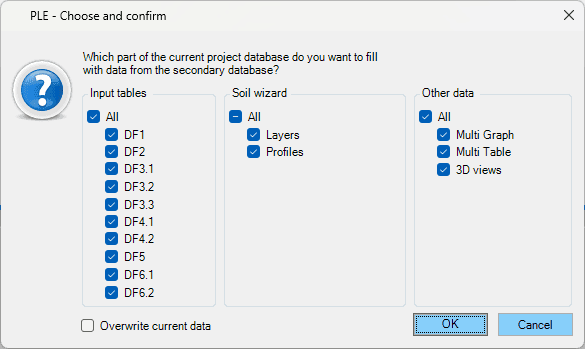
- Overhaul of the import from secondary database functionality, allowing fine-grained selection of what to import.
- Clarifications and additions to the help file.
- Numerous small improvements throughout the whole program.
- Quite a lot of bugs have been fixed.
Ple4Win is now PLE
Earlier this year, BT Engineering Group updated their logos and house style. To show how connected all the companies are, all of them have updated their logos to a similar style.
To emphasise that the pipeline engineering program is an essential product of this group, it has also been rebranded. Not only a new logo has been designed, its name is also changed to what most users already called it for a while: PLE.
As part of this change, a new website with a new web-address has been launched. Please take a look at https://ple.software/

Axial buckling and Implosion moment
The current implosion data has been expanded, now showing implosion caused by external pressure, bending moment and combined pressure/moment in 3 different columns in the RDPLMAX and RMAXNEN output tables. Also, the fabrication method can now be entered in the MATL table and is used for more accurate calculations. The implosion warnings have also been improved with these implosion changes.
A material factor can now be entered in the MATL table, it is used with adapted and improved axial buckling calculations. These are now in accordance with NEN 3650-2:2020+A1:2024. This comes with more clearer warnings for when the buckling strain, torsion strain or the combined check becomes critical or fails.
Detailed import from the secondary database
The functionality to import data from a secondary database has been extended to include more options. A choice can now be made which of the design functions are going to be imported. Furthermore, the soil wizard’s soil layers and/or profiles can now be imported. Finally, the Multi Graph data, Multi table data and 3D views settings can also be selected individually for import. Lastly the Multi Graph data, Multi table data and 3D views settings can be copied over from the secondary database.
New licensing method
We have updated the internal workings of our software to allow a different licence type than the currently used hardware dongles. It is now possible to use the computer’s hardware as the basis for licensing, allowing usage of the program without a physical dongle, albeit having the licence locked to that computer (moving the licence to a different computer is then not possible without assistance from EDS).
Note that hardware dongles are still fully supported and will remain supported. Please contact EDS for more information and if you are interested to change your licence from a dongle to a device.
Soil wizard overhaul
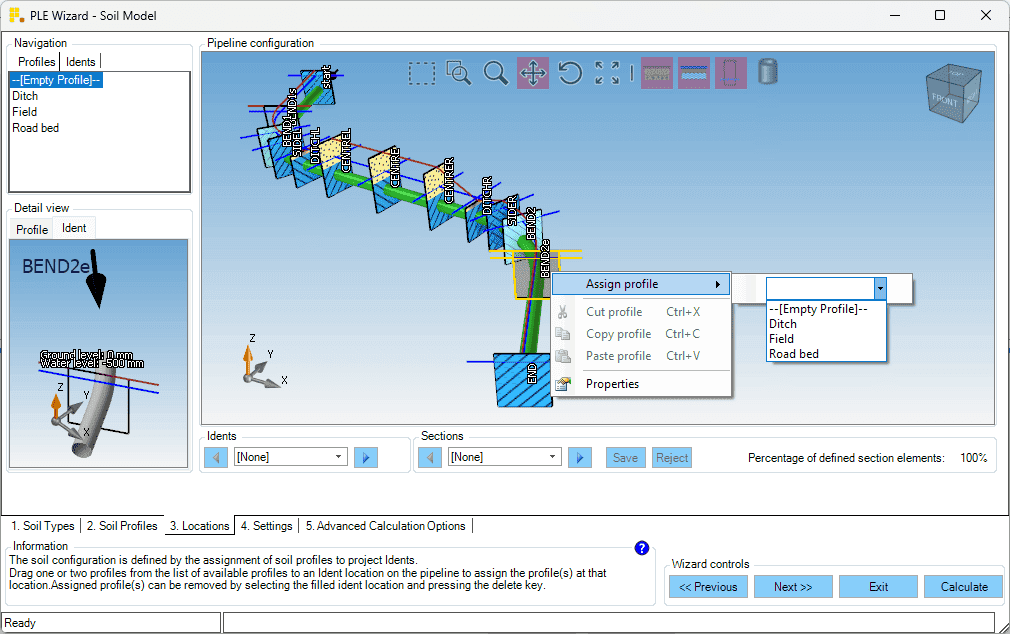
The soil wizard’s User Interface has been changed and updated. The location editor has been merged into the Locations tab. Profiles can now be assigned to idents without opening a new window.
On the Advanced Calculation Options tab (tab 5), the category-dropdown box has been changed to a bullet point list, making it much clearer that there are multiple categories of advanced options. By choosing a bullet-point the corresponding advanced settings will be changed to the correct view.
Courses for PLE users
As experienced PLE users know, the performance, accuracy, and speed of pipeline projects depend to a large extent on how well the project is modelled. A well-designed pipeline model can often have greater benefits than simply having a faster computer, and can prevent the need for extensive calculations on model variations.
To help users master the art of creating good, functional pipeline models, we are offering a half-day course. This course is designed for experienced users who want to refine their modelling skills and learn advanced techniques.
In addition to our experienced user course, we also offer training for new users as well as customised training for individuals or small groups. This training can be tailored to your specific needs and can address any particular challenges you may be facing.
The combination of a course and assistance with a project to be calculated is also possible. Again, contact us for more information.
PLE forum
For support or advice, please visit the PLE forum. There you can also read the FAQs, tips & tricks, report your findings or tell us your views.